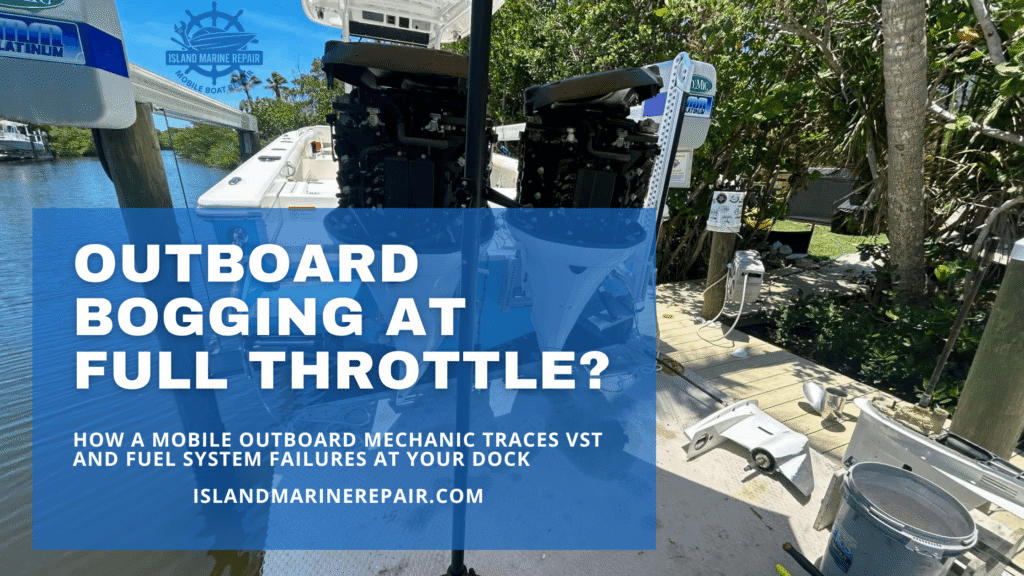
Outboard bogging down at full throttle has a way of showing up at the worst possible moment. The engine idles like a sewing machine at the dock, purrs through the no-wake zone, and climbs onto plane just fine on a calm morning. Then you point the bow toward the pass, bury the throttle to beat an afternoon storm home across Pine Island Sound, and the motor falls flat on its face. It stumbles, coughs, drops a few hundred RPM, and refuses to give you the top end you paid for. Ease off the throttle and it smooths right out. Push it again and the same thing happens.
If that sounds like your boat, take a breath. This is one of the most common calls we run at Island Marine Repair LLC during a busy Southwest Florida season, and nine times out of ten it is not a blown powerhead or a five-figure repair. It is fuel starvation. Your engine is starving for fuel at exactly the moment it needs the most of it, and in our heat, humidity, and ethanol-blended gas, that problem shows up at the dock more often than a July thunderstorm.
This guide walks through why the bog happens, the symptoms of a clogged VST filter, what the vapor separator tank has to do with it, a few safe checks you can run yourself, and how a mobile outboard mechanic traces the failure right there in your slip without ever hauling the boat to a shop.
Why Outboard Bogging Only Happens at Wide Open Throttle
The most confusing part of this problem is that the engine seems perfectly healthy until you ask it to work hard. That is not random. It is physics.
At idle and trolling speed, your outboard sips fuel. The demand on the fuel system is almost nothing, so a partial restriction anywhere in the line goes completely unnoticed. Everything downstream still gets all the fuel it needs, because the need is tiny.
Wide open throttle flips that on its head. At full throttle the engine demands maximum fuel volume and maximum fuel pressure at the same time. A restriction that was invisible at low speed suddenly becomes a wall. The engine calls for more fuel than the clog can pass, the mixture leans out, and the motor bogs. This is the exact moment your outboard loses power under load, right when you need every bit of it. When you back off, demand drops below the choke point and the engine recovers. That recover-the-instant-you-ease-off signature is the classic fingerprint of fuel starvation, and it is the first thing an experienced marine mechanic listens for.
Two things make it worse in our waters. Heat pushes fuel toward vapor, which the fuel system has to fight harder to manage on a 95 degree day with a hot engine box. And humidity combined with ethanol pulls water and varnish into the fuel system faster than almost anywhere else in the country. So the same restriction that might take years to build up north can show up in a single Florida summer.

Symptoms of a Clogged VST Filter and a Struggling Fuel System
Before we get into the fix, it helps to know what you are looking for. A clogged VST filter and the wider fuel delivery problems that cause outboard bogging tend to produce a recognizable set of symptoms. If you notice several of these together, fuel starvation is almost certainly the culprit.
Your engine idles and runs fine at low speed but bogs, stumbles, or dies when you push toward wide open throttle. The motor hesitates or surges under acceleration. It struggles to reach its rated top-end RPM, or it hits a ceiling well below where it used to run. It stalls or nearly stalls when the load comes on. Performance gets noticeably worse in hot weather, or after the boat has been sitting for a few weeks between trips. And the problem clears up the moment you reduce throttle, only to return the next time you punch it.
Those are the textbook symptoms of a clogged VST filter, a weak fuel pump, or a restriction upstream of the engine. The good news is that all of them are traceable, and most are fixable at your dock in a single visit.
Meet the VST, the Part Florida Loves to Clog
To understand where the restriction hides, you need to know how fuel actually reaches the injectors on a modern electronic fuel injection outboard. It travels through a two-stage pump system.
First, a low-pressure lift pump pulls fuel out of your boat’s main tank and moves it up to the engine. Second, that fuel drops into a small reservoir bolted to the powerhead called the vapor separator tank, or VST. Mercury Verado engines call the same component a Fuel Supply Module, but it does the same job. Inside that tank sits a high-pressure electric fuel pump that pressurizes the fuel and forces it into the fuel rail and injectors.
The VST does two important jobs. It separates fuel vapor from liquid fuel so the high-pressure fuel pump always has a bubble-free pool to draw from, which is what protects you from vapor lock in the heat. And it acts as a buffer so the injectors get a steady supply even when the boat is bouncing and the tank is sloshing.
Inside that small tank you will find a fine mesh inlet screen at the base of the high-pressure pump, a float and needle valve that controls the fuel level, the high-pressure fuel pump itself, a pressure regulator, and a small vent or carbon canister up top that lets air escape as the tank fills. Every one of those parts is a potential choke point, and Florida attacks nearly all of them.
This matters here more than most places because Mercury and Yamaha dominate the Southwest Florida fleet, and both brands rely on this VST design. When we get called out for a fuel injector and VST cleaning service, the tiny inlet screen inside the tank is very often the villain. Ethanol acts like a solvent inside old rubber fuel lines, loosening varnish and crud that then travels downstream and lands right on that fine screen. The high-pressure pump then has to work harder to pull fuel through the clog, it cavitates, and the injectors go hungry at exactly the moment you open the throttle.
Before You Call Anyone, Run This Quick Dock Test

You can rule out several of the most common causes yourself in a few minutes with nothing but your own two hands. None of these require tools, and they are safe to do at the dock. If one of them solves the problem, you just saved yourself a service call.
The fuel cap test. The next time the engine bogs at speed, briefly loosen the fuel tank cap or open the tank vent, then try the throttle again. If power comes right back, your tank vent is blocked and the engine was fighting a vacuum. This is shockingly common in Florida because mud daubers and other insects love to build nests inside vent hoses. A blocked vent lets the boat run a few minutes at speed, then the vacuum builds until the engine simply cannot pull fuel and it starves.
The primer bulb test. With the engine running under load, watch or feel the primer bulb. A healthy bulb stays firm. If it collapses flat when you throttle up, there is a restriction upstream of the engine. That points to a clogged water-separating fuel filter, a kinked or collapsed hose, or a stuck anti-siphon valve at the tank. A bulb that goes soft under demand is telling you the engine is trying to pull fuel through something it cannot get through.
The jar test. Spin off your water-separating fuel filter and pour the contents into a clear glass jar. Let it sit for a minute. If you see water droplets settle to the bottom, or a dark, cloudy layer separating out, you have found contaminated fuel and ethanol phase separation. This happens constantly here when a downpour floods a poorly sealed gas cap, or when ethanol pulls moisture out of our humid air overnight.
Note the details. Write down the exact RPM where the bog starts and whether the engine recovers when you ease off. That information is gold to a mechanic and can cut diagnosis time in half.
If you want to work through the problem more thoroughly on your own first, our full outboard engine troubleshooting checklist walks through these steps and more in order, from cheapest and easiest to most involved. Just know your limit. Everything past the checks above involves fuel pressure gauges, electrical testing, and opening pressurized fuel components, which is where a professional earns the fee.
How a Mobile Outboard Mechanic Traces It at Your Dock
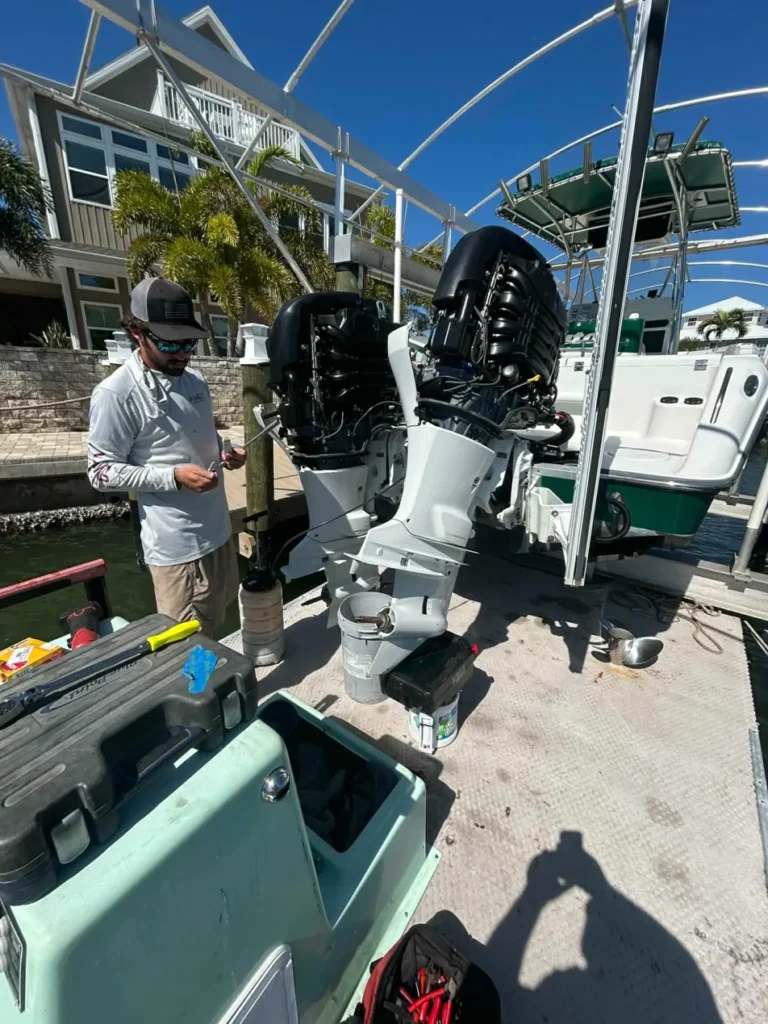
Here is the part most boat owners do not realize. The biggest advantage of having the work done in your slip is that the engine can be load-tested on the water. You cannot reproduce a true wide open throttle bog on flush muffs in the driveway. There is no prop pushing water, so there is no real load, and the fuel system never gets stressed the way it does when the boat is actually trying to move. Any shop that tells you the problem is fixed because the engine revs clean on muffs has not tested the thing that was broken.
A good mobile outboard mechanic follows a strict order of elimination, working from the tank toward the injectors so no money gets spent on the wrong part.
Foundation checks first. Before touching the fuel system, a mechanic confirms the engine’s basics are solid. A quick compression test verifies every cylinder is making acceptable pressure and that all cylinders are within about ten percent of each other. A spark check confirms strong, consistent spark on each cylinder. Ruling out a mechanical or ignition problem first keeps the diagnosis honest.
The spray test. To confirm the engine is genuinely starving, a tech can introduce a small shot of fuel directly into the intake while the engine is bogging. If the motor immediately picks up and the bog clears, that is a definitive sign it was short on fuel. Now the hunt is narrowed to fuel delivery.
The transparent line trick. Professionals often splice a section of clear fuel line into the system for diagnosis. Watching fuel move through a see-through line reveals air bubbles, aeration, and cloudiness in real time, which pinpoints exactly where air might be sneaking in, whether at a loose fitting, a tired hose clamp, or a cracked line.
Fuel pressure under real load. This is the test that settles it. A mechanic connects a fuel pressure gauge to the test port on the fuel rail or VST and reads pressure in stages. Key-on to confirm the high-pressure fuel pump primes and builds pressure. At idle to confirm it holds a stable reading in the normal range for the engine. Then the important one, under full throttle in gear right there in the canal, watching for the pressure to sag as the RPMs flatten. On many Yamaha outboards, for example, VST fuel pressure should hold and not drop below the low forties under load. A reading that collapses when the engine bogs confirms a fuel delivery restriction or a failing pump.
Draining and opening the VST. Once the VST is the suspect, the tech depressurizes the system and drains fuel from the bottom of the tank into a clear container. Water or phase separation means bad gas is the root cause. Black specks or sludge usually mean a rubber fuel line somewhere is breaking down and shedding debris. If the drained fuel looks clean but pressure still dropped under load, the housing comes open at the dock so the mechanic can inspect that fine inlet screen, check the float and needle valve for sticking, and clear the vent or carbon canister, which loves to plug up with salt residue and choke the tank’s ability to fill fast enough at high RPM.
Electrical testing the pump. If the screen is spotless, the pump itself may be failing. Boat fuel pump problems are one of the most common reasons a fuel system cannot keep up under load. A multimeter confirms the wiring harness is delivering proper voltage to the pump and that the pump’s internal motor still has continuity and has not burned out.
Because a mobile boat mechanic carries the gauges, clear lines, common filters, and replacement pumps to your dock, most of this can happen in a single visit. A complete outboard boat service also gives the tech a chance to catch the small things that cause outboard bogging before they leave you stranded, like a softening fuel line or a filter that is halfway to clogged.
The Florida Five: What Is Really Behind Most Bogs Down Here
After enough dockside diagnoses in Lee County waters, the same handful of causes come up again and again. If you are dealing with outboard bogging at full throttle, the odds are heavy that one of these five is the reason.
- A clogged VST inlet screen. The most common culprit by far. Aging ethanol-soaked fuel lines shed varnish and debris that collect on the fine screen inside the tank, and the high-pressure fuel pump can no longer pull enough fuel through it.
- Water in the water-separating fuel filter. Our humidity condenses inside a partially filled tank overnight, and ethanol grabs that moisture and holds it. That water ends up in the filter bowl and eventually in the fuel the engine is trying to burn.
- A tired low-pressure lift pump. This is the pump that keeps the VST full. If it weakens and cannot keep up with high-RPM demand, the VST runs low, the high-pressure pump sucks air, and the engine leans out and bogs.
- A stuck anti-siphon valve. The brass fitting where the fuel line leaves the tank contains a small check valve. In our saltwater environment those brass parts corrode and stick partway shut, quietly strangling fuel flow under load.
- A warped primer bulb check valve. The little one-way flaps inside a primer bulb warp in the heat and restrict flow when the engine tries to pull hard. A five dollar part can be the whole problem.
A few honorable mentions round out the list. The inner plastic liner of an old fuel line can delaminate and collapse under wide open throttle suction while looking perfectly fine on the outside. A spun propeller hub will let the engine rev freely with no matching boat speed, which feels like a bog but is actually a mechanical slip. An over-pitched propeller keeps the engine from ever reaching its rated RPM. And an ignition component that is strong at idle can misfire under the higher cylinder pressure of full throttle. A proper diagnosis separates these quickly so you are not throwing fuel parts at a propeller problem.
What a Real Fix Looks Like

To put all of this in context, one job that shows the whole process well is the Mercury 60HP VST and fuel pump service we completed in Fort Myers. The symptom was textbook, a clean idle with a bog that arrived under load. The fuel pressure held at idle but sagged the moment the engine was pushed. Pulling the VST revealed an inlet screen packed with varnish, and the high-pressure fuel pump came up weak on the flow test. After cleaning the tank, addressing the screen, and restoring proper pressure, the bog was gone and the engine hit its factory top-end RPM again. No haul-out, no guessing, and no replacing parts that were never the problem.
Stop the Bog Before It Starts
The best fuel system repair is the one you never need. A few habits go a long way toward keeping outboard bogging out of your season in Southwest Florida.
Run ethanol-free fuel, often sold as Rec 90, whenever you can find it. Yes, it costs a little more per gallon, but E10 pump gas can phase-separate in as little as three weeks sitting in a hot boat, and the water it pulls in is what destroys VST pump internals and clogs the inlet screen. Over the life of your fuel system, ethanol-free is cheaper than the repairs ethanol causes.
If you have to run E10, treat every fill-up with a quality marine fuel stabilizer or enzyme treatment to fight moisture. Try not to let fuel sit for long stretches, and keep your tank topped off when the boat is idle to cut down on the air space where condensation forms. Replace your water-separating fuel filter on a regular schedule rather than waiting for it to clog, since it is one of the cheapest parts on the whole boat.
One firm rule, never put E15 in a marine engine. It is illegal to use in recreational boats under federal law, it will damage your fuel system, and it voids your engine warranty. Stick to marine-rated or Rec 90 fuel.
When to Stop Testing and Call for a Dockside Diagnosis
DIY checks are great for the easy wins, but a few signs mean it is time to bring in a professional before you do real damage.
Call for a diagnosis if fuel pressure will not hold under load, if the engine is throwing a check-engine light or storing fault codes that need a scan tool to read, if you find water or metal flakes in the gear oil, if a temperature alarm shows up alongside the bog, or if the engine keeps running lean with white, chalky spark plugs. That last one is important. A persistent lean condition at wide open throttle can scuff a piston in a hurry, so if the motor keeps leaning out, shut it down rather than continuing to test.
The whole point of a mobile service is that you skip the trailer and the shop queue entirely. We bring the pressure gauges, the clear diagnostic lines, the scan tools, and the common VST, pump, and filter parts right to your slip, load-test the engine in your own canal, and get most fuel system jobs handled the same visit. Whether you keep your boat in Fort Myers, Fort Myers Beach, or need mobile boat repair in Cape Coral, the diagnosis happens where your boat lives.
If your outboard is bogging at full throttle right now, do not spend another weekend fighting it. Book a dockside fuel system diagnosis and let us load-test it, trace the restriction, and get you back to chasing reds before the tide changes.
Frequently Asked Questions
What causes outboard bogging down at full throttle?
Most of the time it is fuel starvation. At full throttle the engine needs maximum fuel volume and pressure, so any restriction that hides at idle, like a clogged VST filter, a weak fuel pump, a blocked tank vent, or a dirty water-separating filter, chokes the engine right when it needs the most fuel. The mixture leans out and the motor bogs, then recovers the second you back off the throttle. That recover-when-you-ease-off behavior is the clearest sign the problem is fuel delivery rather than a mechanical failure.
What are the symptoms of a clogged VST filter?
A clogged VST filter usually shows up as bogging or stumbling at wide open throttle while the engine idles and cruises fine at low speed. You may notice the engine cannot reach its rated top-end RPM, hesitates under acceleration, or nearly stalls when the load comes on. Symptoms often get worse in hot weather or after the boat has been sitting. Because the vapor separator tank feeds the high-pressure fuel pump, a clogged screen starves the injectors exactly when demand peaks.
How do I know if it is a fuel problem or the propeller?
Watch your tachometer at full throttle. If the RPMs stay below the engine’s rated range while the motor labors, you likely have a fuel restriction or an over-pitched propeller. If the RPMs climb high but the boat does not accelerate, you probably have a spun propeller hub, which is a mechanical slip rather than a fuel issue. A quick dockside check separates the two so you fix the right thing.
Is it safe to keep running an outboard that bogs at wide open throttle?
It is risky, especially if the engine is running lean. A lean condition at full throttle raises combustion temperatures and can scuff or damage a piston fairly quickly. If your spark plugs are coming out white or chalky, or the bog is getting worse, stop pushing the engine and get it diagnosed. Continuing to run a starving engine to save a service call can turn a minor fuel repair into a major powerhead rebuild.
Do I need to trailer my boat, or can this be fixed at the dock?
Most fuel system and VST work can be done right at your dock. In fact, dockside is better, because the engine can be load-tested on the water, which is the only way to reproduce a true full-throttle bog. A mobile outboard mechanic brings the gauges, tools, and common parts to your slip, diagnoses the problem under real load, and completes the majority of these repairs in a single visit with no haul-out required.
Island Marine Repair LLC provides expert mobile outboard service throughout Fort Myers, Fort Myers Beach, Cape Coral, Naples, Punta Gorda, Captiva, and Sanibel. Mercury, Yamaha, Suzuki, and Honda outboards serviced right at your dock. Contact us today to schedule a dockside fuel system diagnosis.