Knowing how to flush an outboard motor after saltwater sounds simple until you read three guides and get three different answers. One says run the engine. Another says never start it. A third swears by a ten-minute rule your manual never mentions.
They can all be right, for different engines. That’s the catch. The flush takes a few minutes, but the method, the time and whether the engine runs depend on the outboard hanging on your transom.
At Island Marine Repair, the flushing problems we find at the dock rarely come from owners who skip the job. They come from owners who flush every trip with a method meant for a different engine. What follows is what the manufacturer documents actually say, with Mercury examples, and where Southwest Florida water changes the routine.
Quick Answer: How to Flush an Outboard Motor After Saltwater
Run fresh water through the cooling system after every saltwater or brackish trip, using the method your owner’s manual names for that engine, then rinse the outside. The two common methods look like this:
- Flush port (many late-model engines): engine vertical, hose on the flush fitting, water on, engine off, run for the manual’s time (Mercury’s quick tip says about 10 minutes), water off, cap back on.
- Earmuffs (running flush): prop off, muffs centered over the intakes, water on first, start in neutral at idle, confirm a steady tell-tale, run the manual’s time, engine off before the water.
Why Flushing Matters More in Southwest Florida
Your outboard cools itself with the water it floats in. A pump pulls that water through passages around the powerhead and sends it back overboard. When the engine shuts down and the passages drain, the water evaporates. The salt stays.
One trip leaves a film. A season of skipped or half-done flushes lets salt build up through the cooling system, as crust in narrow passages, around the thermostat and at the tell-tale outlet. That residue can feed corrosion and deposits over time, especially when the engine sees saltwater again and again without a proper flush.
Mercury recommends flushing and rinsing after each saltwater use and extends that to brackish, polluted or very silty water. Its service literature goes further, calling the flush after salty or brackish operation required maintenance and noting that the limited warranty excludes damage from skipped routine maintenance.
It’s the easiest habit in outboard saltwater maintenance, and one of the easiest to do halfway. Flushing belongs on the same short list of maintenance checks Florida boat owners tend to miss, right alongside bilge pumps and fuel filters.
Fort Myers, Cape Coral and the Brackish Water Trap
Local boating makes this tricky. A run from a Cape Coral canal down the Caloosahatchee River to Pine Island Sound can cross water that ranges from mostly fresh to strongly salty, and salinity in the river and canals shifts with tide, rain and freshwater releases upstream.
So the water at your dock says little about what went through the engine. Anyone who fishes the flats off Sanibel knows the other half of the problem: shallow running pulls sand and silt into the intakes along with the salt. The simple rule here is to flush after any trip through tidal, salt or brackish water.
Flush Port vs. Earmuffs: Which Method Does Your Engine Use?
Two methods cover most outboards. Some engines support both. Some support only one.
| Method | How it works | Engine running? |
|---|---|---|
| Flush port (Mercury calls it Flush Connect on many late-model engines) | A garden hose connects to a fitting on the engine and feeds fresh water into the cooling system | Often off on late-model designs; the manual decides |
| Flushing muffs (earmuffs) | Rubber cups clamp over the gearcase water intakes and feed hose water to the pump | Usually at idle in neutral, propeller removed |
| Model-specific attachment or container | Some small and older engines use a dedicated attachment or a flush bag | Varies by model |
Flush Port, Water Intake or Tell-Tale?
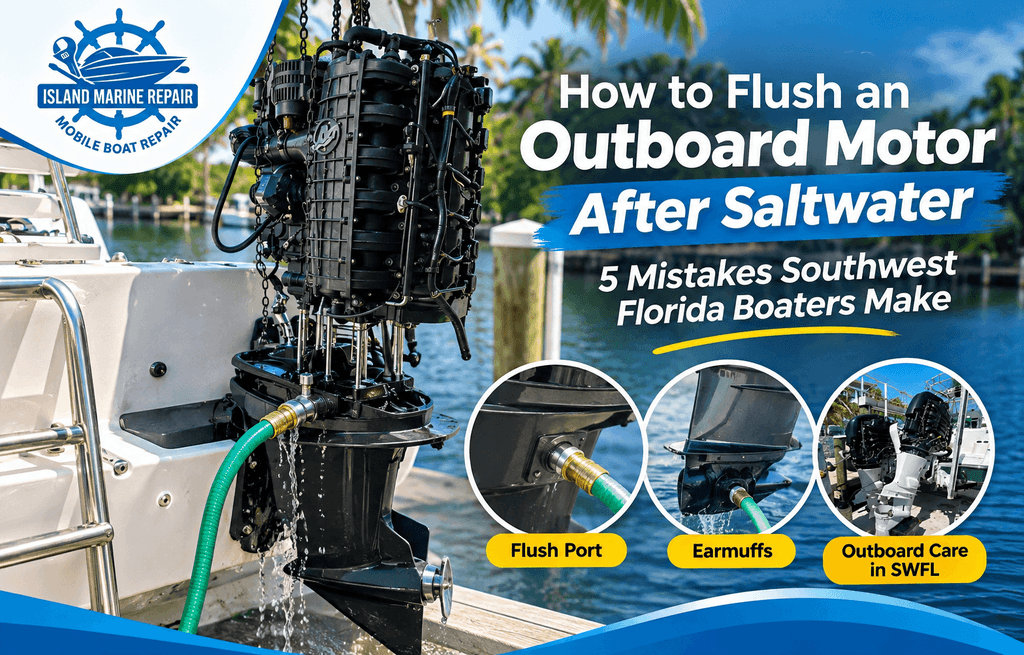
Three parts get confused, and each mix-up ruins a flush. The flush port is where the hose connects. The water intakes are the gearcase openings the engine draws from underway, and muffs cover them. The tell-tale is the small stream from the side or back of the engine that shows the pump is moving water.
A hose jammed into the tell-tale outlet flushes nothing useful. Neither does a muff clamped above the intakes.
Do You Need an Outboard Flush Kit?
Maybe. “Flush kit” can mean muffs, a flush port adapter, a quick-connect fitting or a salt-remover applicator. An engine with a dedicated port may need nothing beyond a good hose.
An engine that flushes through the gearcase needs muffs sized for that gearcase, and some performance gearcases have extra nose inlets that need their own seal. Buy for your engine, not the shelf.
How to Flush an Outboard Motor After Saltwater, Step by Step
Both methods follow the same basic order. Where your manual differs, the manual wins.
Step 1: Position the Engine
Lower the outboard to vertical unless your manual says otherwise. Vertical also matters for the rinse later, since Mercury warns that rinsing a tilted engine can push water into the air intake at the rear of the cowl.
Step 2: Confirm the Method, Running Rule and Time
Before the hose goes on, check three things in the manual: where the water connects, whether the engine runs, and for how long. Thirty seconds of reading beats a guess.
Step 3: Connect Fresh Water and Set the Flow
For a flush port, remove the cap or plug and thread the fitting on straight, hand tight. With earmuffs, center the cups over every intake and squeeze them tight to the gearcase.
Flow matters more than force. Mercury’s muff procedures call for enough water that some leaks out around the cups, proof the pump has more than it can use. Plenty of online instructions say to open the tap all the way, yet some Mercury hose-fitting procedures say to open it only partway. Steady and sufficient beats blasting.
Step 4: Follow the Engine-Running Instructions
For an engine-off flush, leave the key alone and let the water run. If your procedure requires the engine to run:
- Remove the propeller first. Mercury lists this as a safety step for running on a flushing attachment.
- Turn the water on before you crank.
- Start in neutral and stay at idle. Mercury warns against running above idle while flushing.
- Confirm a steady tell-tale right away. No stream, shut it down.
- Stay with the boat. A muff that slips off a running engine starves the pump in seconds.
Step 5: Flush for Your Manual’s Time
There’s no universal number, and the next section shows why. Use the manual’s time and don’t trim it because the trip was short.
Step 6: Shut Down in the Right Order
On a running flush, Mercury’s order is engine off, then water off, then remove the attachment and reinstall the prop. On an engine-off flush, shut the water, disconnect and put the cap or plug back. A missing flush plug is easy to forget.
Step 7: Let It Drain
Leave the engine down so the cooling passages drain before you tilt it up for storage.
How to Rinse an Outboard Motor After Saltwater
The flush cleans the inside. The rinse cleans the outside, and it’s a separate job. With the engine vertical, rinse the cowl, mounting bracket, trim rams, steering linkage and prop area with a gentle stream, keeping water away from the air intake.
Owners on boating forums, including one Fort Myers pontoon owner, describe steering arms and trim parts rusting through even with the inside flushed every trip. Salt on the outside does its own damage, and the prop hub is a favorite hiding spot.
Do You Need to Run the Engine, and How Long Should You Flush?
These answers change with the method. Here’s what published Mercury procedures show across different engines:
| Source | Method | Engine | Time |
|---|---|---|---|
| Mercury quick tip for engines with a flush connector | Hose on the connector, engine vertical | Off | About 10 minutes |
| Mercury owner’s manuals for several outboards, including a 60 FourStroke | Muffs over the gearcase intakes, prop removed | Idle in neutral | 3 to 5 minutes |
| Some Mercury hose-fitting procedures | Hose on a rear or cowl fitting | Off, idle or required to run, per that manual | 3 to 5 minutes or more |
One brand, three procedures. That’s why “flush for 10 minutes” fails as a universal rule, and why most arguments about how to flush an outboard motor after saltwater go in circles. People are describing different engines.
The same goes for a rule repeated almost everywhere online: never start the engine on a flush port. It holds for many late-model designs, Mercury’s included. Yet at least one Mercury manual for an engine with a rear hose fitting says the engine must run during flushing to open the thermostat.
So how long should you flush an outboard? As long as your manual says for that method, and no shorter. Forum threads land anywhere from 3 to 10 minutes, and one boater suggested tasting the tell-tale for salt. Skip the tasting.
Flushing in the Water, Without Earmuffs or Without a Hose
Can You Flush an Outboard While the Boat Is Still in the Water?
Often, yes. Mercury states that engines with its dedicated flush fitting can be flushed on a trailer or in the water, which suits Cape Coral canal homes and marina slips.
Engines that flush through the gearcase intakes are different. Muffs can’t seal underwater, so the lower unit has to come out on a lift or trailer, or the manual has to approve another setup such as a flush bag. Most flush bags require pulling the prop.
Can You Flush an Outboard Without Earmuffs?
Yes, if it has a dedicated flush port. That’s what the port is for.
Without one, use the attachment or container method your manual names. Mercury sells different flushing attachments for different small and mid-size models, which shows how specific this gets. Skip the homemade adapters.
No Hose at the Ramp?
Flush at home, the same day. Some owners carry a container and a small pump, and one forum member flushes from a bilge pump dropped in a five-gallon bucket. That only works if it delivers the flow your procedure needs. A weak trickle through a running engine can starve the pump, so a short wait for a real hose is the safer call.
Mercury Outboard Flushing: Flush Port Location and Model Notes
Where Is the Mercury Outboard Flush Port?
Mercury says most late-model outboards from 70 to 400 hp have a Flush Connect fitting in the lower cowl that takes a standard garden hose. That’s more precise than the “side or rear of the engine” answer you’ll often see. Smaller and older models do place the fitting elsewhere, and some use a threaded plug that accepts a hose adapter.
Your operation and maintenance manual shows the exact spot. If the cap is missing or the fitting is crusted with salt, sort it out before the next trip. It’s an easy thing to handle during routine Mercury outboard service.
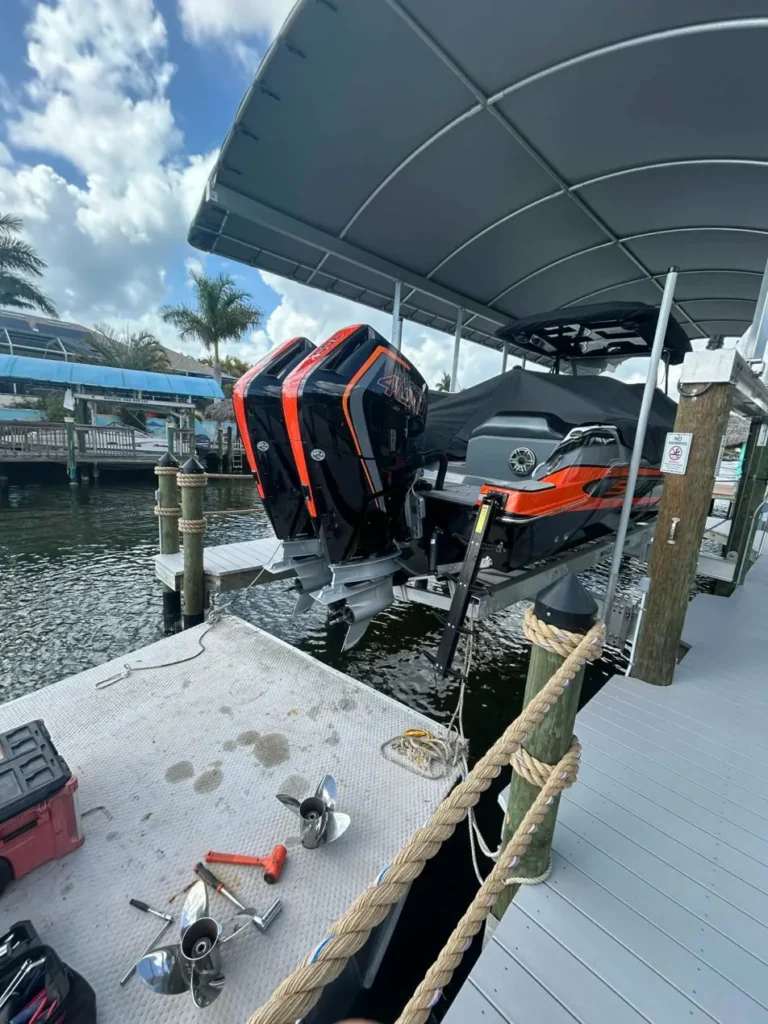
How to Flush a Mercury 4-Stroke Outboard
For a FourStroke with a flush connector, Mercury’s quick tip is plain. Lower the engine to vertical, connect the hose, let the water run about 10 minutes, and don’t start the engine. Mercury’s owner resources show the same steps on video.
How to Flush a Mercury 40-60 HP FourStroke
Mercury publishes dedicated maintenance guidance for its 40-60 HP FourStroke family, including an official freshwater flush video. Watch that one, not a video of a 250.
The owner’s manual for one Mercury 60 FourStroke describes muffs over the gearcase intakes, the engine idling in neutral and the propeller removed, for 3 to 5 minutes. That’s a different routine from the engine-off flush on many larger Mercury models. Model year and gearcase can change the details, so don’t assume every 60 HP flushes the same way.
How to Flush a Mercury 2-Stroke Outboard
Older Mercury 2-strokes span decades of designs, so there’s no single procedure. Several manuals describe muffs tight over the gearcase intakes, water adjusted to leak around the cups, the engine idling in neutral for 3 to 5 minutes and the prop removed. Some larger models have a hose fitting where the manual allows the engine stopped or idling.
Important: Mercury 2-strokes are not interchangeable. Identify your model and serial number, and follow that manual before you connect a hose or turn a key.
What Is the Best Outboard Flush Solution?
Fresh water, through the method your manual names, after every saltwater or brackish run. Search results often answer this question with a shopping list of chemicals. Products help in specific cases, but they sit on top of that foundation, not in place of it.
- Your manufacturer’s freshwater procedure
- Enough flow, set the way the manual describes
- Consistency, every trip, short ones included
- A salt-removing product, if you want extra help with residue
- Professional cleaning or descaling when deposits are already a problem
Should You Use Salt-Away on an Outboard?
Salt-Away, Salt-Off and similar salt removers are concentrates meant to break down salt residue. Salt-Away is dispensed through its own mixing unit on the hose and works with muffs or a flush port.
In one long forum thread, an owner credited it with stopping sticky check valves on his flush lines, while another heard mixed opinions until his mechanic recommended it. Useful anecdotes. Not engineering data.
None of these products replaces the freshwater flush, repairs corrosion or clears a blocked passage. If you use one, follow its directions and confirm it fits your engine maker’s guidance.
Can You Use Vinegar to Flush an Outboard?
Some guides suggest a vinegar soak, or a vinegar and dish soap mix, for mineral scale. Neither is part of Mercury’s routine flushing procedure.
Vinegar is an acid, and even the guides that recommend it warn it can attack zinc anodes and thermostats. Seals, coatings and gaskets vary by engine, too. If you suspect scale, find out what’s restricting flow before pouring anything in.
Rydlyme and Other Chemical Descalers
Rydlyme is a marine descaler made to dissolve calcium, lime and rust deposits in cooling systems. That’s a different job from flushing.
Descalers are typically recirculated for hours, and product information in this category lists metals to keep them away from, such as zinc and magnesium. We mention it because owners search for it, not as an endorsement. Treat any descaler as a specialized treatment, not post-trip maintenance.
Flushing vs. Descaling: How to Remove Scale From an Outboard
Salt residue and mineral scale are different problems. Residue is what a routine flush clears. Scale is a hard deposit that forms when residue keeps getting left behind, or when an overheat bakes what’s in the passages.
| Routine freshwater flush | Chemical descaling | |
|---|---|---|
| Purpose | Clear salt and silt after each use | Dissolve hardened mineral deposits |
| When | After every saltwater or brackish run | When deposits are confirmed |
| Time | Minutes, per the manual | Hours of circulation, per the product |
| Risk if done wrong | Low when the method matches the engine | Damaged anodes, seals or coatings, and a missed root cause |
The catch: weak cooling flow has several causes. Scale is one. A worn water pump, a stuck thermostat or debris in a passage are others.
Sorting one from another is the job of proper marine engine diagnostics, not guesswork with a jug of chemicals. Descaling an engine with a pump problem fixes nothing.
5 Outboard Flushing Mistakes Southwest Florida Boaters Make
Mistake 1: Assuming Every Outboard Flushes the Same Way
This is the big one. Most bad advice about how to flush an outboard motor after saltwater comes from a video filmed on a different engine. An owner copies it, then starts a motor the manual says to flush with the key off, or leaves the key off on an engine whose procedure needs the pump running. Find your procedure once, then repeat it every time.
Mistake 2: Starving the Engine of Water
Muffs drift off-center. A kinked hose cuts flow. A second set of intakes stays uncovered and the pump sucks air.
Someone nudges the throttle above idle. Each one leaves the pump short while the tell-tale still dribbles enough to look fine. Watch the stream the whole time.
Mistake 3: Treating Brackish Water as Fresh Enough
Plenty of Fort Myers and Cape Coral owners skip the flush after a river or canal day because the water “wasn’t that salty.” Mercury recommends flushing after brackish operation, and brackish water still corrodes. River and canal water carries silt, too. Flush it like saltwater.
Mistake 4: Skipping Short Trips and Waiting Too Long
A 20-minute run to the sandbar puts salt in the engine just like a day offshore. Flush every trip, the same day, while you unload. Mercury’s quick tip frames it that way: the flush is done by the time the tackle and cooler are off.
Mistake 5: Relying on Flushing When Something Else Is Wrong
Flushing is prevention. It won’t fix a failing pump, a stuck thermostat or a passage that’s already blocked.
If the tell-tale stays weak after a correct flush, stop treating it as maintenance. An engine that keeps overheating at idle after a fresh flush is telling you something a garden hose can’t reach.
When Flushing Is No Longer Enough
Book an inspection instead of another flush if you see:
- A tell-tale that stays weak or quits after a correct flush
- Repeated temperature or overheat warnings
- An engine that overheated before you could flush it
- White crust or heavy corrosion around the tell-tale, cowl or gearcase
- An engine that sat unflushed for weeks and now moves less water
An engine with a suspected cooling problem shouldn’t be run until the cause is known, which is the best argument for having it checked where it sits. Mobile outboard motor service brings the diagnosis to the dock or the lift, so the engine only runs once it’s safe to.
Southwest Florida Outboard Flushing Checklist
Keep this near the hose, or tape it inside the console. It’s the same sequence any good mobile boat mechanic in Fort Myers follows before calling a flush done.
Before the flush
- Method confirmed: flush port or muffs
- Running rule and time confirmed in the manual
- Engine vertical unless the manual says otherwise
- Prop off if the engine will run on muffs
During the flush
- Water on before any engine start
- Flow set per the manual, with water spilling from the cups on muffs
- Neutral and idle only on a running flush
- Tell-tale steady the whole time, with someone at the boat
After the flush
- Correct shutdown order for your method
- Flush cap or plug back in place
- Engine down to drain
- Exterior rinsed, with water kept out of the air intake
- Anything unusual noted and checked

Frequently Asked Questions
How do you flush an outboard motor after saltwater?
Run fresh water through the cooling system after every saltwater or brackish trip, using the method in your manual: a dedicated flush port, often with the engine off, or muffs with the engine at idle in neutral. Use the manual’s time, then rinse the exterior.
Can you flush an outboard with earmuffs?
Yes, if your manual lists muffs for that engine. Center the cups over every intake, set the flow so water spills around them, pull the prop if the engine will run, and keep it at idle in neutral.
Can you flush an outboard while it’s still in the water?
Many engines with a dedicated flush fitting can, and Mercury says so for its fitting. Engines that flush through the gearcase intakes need the lower unit out of the water or a manual-approved alternative.
Is rinsing the outside the same as flushing?
No. Flushing moves fresh water through the internal cooling passages. Rinsing washes salt off the cowl, bracket, trim and steering parts. A saltwater boat needs both after every trip.
Is a salt remover necessary for an outboard?
No. Fresh water through the correct procedure is the foundation. A salt remover is optional extra help with residue, used per the product’s directions, and it never replaces the freshwater flush.
How do you flush a Mercury 60 HP FourStroke?
Start with Mercury’s official 40-60 HP FourStroke flush video and the manual for your serial number. At least one 60 FourStroke manual calls for muffs with the engine idling and the prop removed, which differs from the engine-off flush on many larger Mercury models.
Is it safe to flush cold tap water through a warm outboard?
It’s a common forum worry borrowed from car engines. An outboard already runs on the water it sits in, and Mercury’s quick tip has you flushing while you unload. Follow your manual’s timing.