Most boat owners do not find out their boat needs a complete rewire from one dramatic failure. It starts small. A navigation light that flickers when the bilge pump kicks on. A battery that keeps going dead over the weekend. A fishfinder that reboots itself every time you hit the trim switch. Individually, each one feels like a minor annoyance you can chase down and fix. Put them together, and they are usually telling you something bigger about the boat’s entire electrical system.
Here in Southwest Florida, that story plays out faster than almost anywhere else. Salt air, year-round humidity, brutal summer heat, and constant vibration are a meat grinder for 12-volt marine wiring, and the non-tinned copper used on a lot of older production boats corrodes from the inside out long before the trouble shows on the surface. As a mobile boat mechanic working these waters, the real question we help owners answer is not “how do I fix this one circuit,” but “has the wiring reached the point where patching individual problems no longer makes sense.”
This guide walks through the specific signs a mechanic looks for, why our local conditions make them so common, and how to tell the difference between a boat that needs one repair and a boat that needs a clean-slate electrical rebuild.
What a “Complete Rewire” Actually Means
A complete rewire does not mean ripping out every electrical part on the boat. It means replacing the deteriorated or improperly installed wiring and rebuilding the distribution system so every circuit is properly sized, protected, terminated, labeled, and routed the way it should be.
Depending on the boat, that can include battery cables and switches, the main positive and negative runs, fuse panels and breakers, grounding and bonding connections, and the circuits feeding your bilge pumps, navigation lights, livewell and washdown pumps, helm, electronics, and accessories. On boats with a cabin and shore power, it can extend to the 120-volt AC side as well.
The goal is not simply to make the lights come on again. It is to build an electrical system you can trust when you are miles from the dock, using finely stranded tinned copper wire, crimped and heat-shrunk terminals, and proper overcurrent protection on every circuit. That is the standard behind a professional complete boat rewiring service, and it is worlds apart from another round of tape-and-splice repairs.
The Clearest Signs Your Boat Needs a Complete Rewire
No single symptom automatically means a rewire. It is when these show up across multiple systems at once that a mechanic starts recommending a full electrical rebuild instead of another patch.
Green Corrosion and “Black Wire Disease”
Some corrosion is normal on a boat. Widespread corrosion is a different animal. Green or white powdery buildup on battery terminals, bus bars, switches, fuse holders, and ground points is advanced oxidation, and it acts like an insulator, choking the flow of current and generating dangerous resistance and heat.
The hidden version is worse. In unsealed connections, salt air wicks up under the insulation and oxidizes the copper inside the wire itself, turning bright metal dull gray or black and leaving it brittle. Strip back a quarter inch of insulation under your console or near the bilge, and if the copper is black instead of shiny, that conductor can no longer carry power efficiently and needs to be replaced. When that condition is system-wide, new terminals will not adhere or conduct cleanly, and spot repairs stop being worth the effort. This kind of saltwater corrosion is the root of a huge share of the marine electrical problems we trace on SWFL boats.
Chronic Electrical Gremlins and Voltage Drop
Intermittent problems that move around the boat are a classic sign of a failing harness rather than one bad part. Lights that dim or flicker when a pump or windlass switches on point to voltage drop from corroded or undersized wiring. Electronics that reboot, freeze, or lose power for no clear reason, especially after a wet ride, point to loose grounds and compromised insulation.
A telling test is voltage at the console. If a meter reads a healthy 12.7 volts across the battery terminals but your gauges or fishfinder see only 11.2 to 11.8 volts with accessories running, the main feeder cables and ground buses have failed internally. Those unstable voltage levels do not just cause annoyance, they slowly destroy expensive electronics. Pinpointing where that drop is happening is exactly what proper marine engine diagnostics and voltage-drop testing are built to do, because the resistance hiding inside a corroded connection is invisible to the eye.
Brittle, Cracked, or Melted Insulation
Florida heat, UV, and salt age wire insulation fast. When the protective jacket turns stiff, cracked, discolored, or crumbles when you touch it, the bare conductor underneath is exposed to shorts. Wires that feel rigid and hard instead of flexible are salt-soaked and near the end of their life.
Any sign of melted insulation, scorching, soot, or heat discoloration near the panel or engine compartment is an active safety hazard, not a maintenance item. And the sharp, plastic-like burning smell near the helm is the single most urgent warning a boat can give you. When insulation breakdown is spread across multiple runs, a full rewire with modern marine-grade wire is the safe and cost-effective fix.
Frequent Blown Fuses and Tripped Breakers
Fuses and breakers exist to protect the boat from overloads and shorts. When they trip or blow repeatedly under normal operation with no obvious overloaded device, that is a primary indicator of compromised insulation, water intrusion, high resistance from corrosion, or degraded wiring that can no longer handle its load. The dangerous mistake is answering a repeatedly tripping breaker by installing a larger fuse. That does not solve the fault, it just removes the protection, and continually resetting a tripping breaker can build enough heat to start a fire.
A “Rat’s Nest” of Non-Marine Wiring and Tape Splices
Open the panel and look at how the boat has been worked on over the years. Twist-on wire nuts, electrical tape splices, household or automotive wire, unsealed butt connectors, and unlabeled dead-end runs are all red flags. Boats get upgraded one accessory at a time, a stereo here, underwater lights there, a new GPS, another battery, and years of that create an unbalanced, undocumented maze behind the panel board.
The core problem is that household solid-core wire, the kind sometimes called Romex, work-hardens and cracks under the constant vibration of a boat, and it lacks the corrosion resistance of tinned marine conductors. Marine standards call for finely stranded, tinned copper wire, crimped and sealed terminals, and fused protection on every circuit for good reason. If you want to understand what correct marine wiring actually looks like, our primer on boat electrical wiring basics for Florida boaters breaks it down. When a boat is a patchwork of these boatyard specials, a clean code-compliant rewire is safer and usually cheaper in the long run than endless spot repairs.

Phantom Battery Drain
A battery that keeps dying overnight, even with all main switches off and gear disconnected, is worth taking seriously. A single bad accessory can cause it, but when the drain cannot be isolated to one circuit, it usually means current is leaking through multiple compromised runs and corroded connections. Salt residue on and around connections can create unintended paths for electricity to bleed away, and a boat that has that problem in several places is telling you the whole distribution system is compromised.
Unreliable Critical Gear
Some circuits you can live without for a day. Others keep you safe. When your bilge pump, navigation lights, or engine-related electrical functions start working intermittently, the stakes are no longer about convenience. A bilge pump that only runs sometimes is a real problem on a boat that sits on a lift or a mooring, which is why we treat any sign of flaky bilge pump installation and repair wiring as a priority rather than a someday item. If safety gear is riding on corroded wiring, that alone can justify a serious look at the whole system.
Rapidly Dissolving Zincs and Stray Current
Here is one owners often miss. If your sacrificial zinc anodes are disappearing in a matter of weeks, or you see rapid, abnormal pitting on your prop, shaft, or through-hulls, you likely have stray DC current leaking into the bilge water or bonding system. That is a serious systemic failure, usually caused by submerged, damaged, or poorly insulated wiring, and it demands immediate professional inspection before it eats through underwater metals.
The 15-to-20-Year Age Factor
Even a lightly used boat has a wiring lifespan. In the harsh, humid, salty marine environment, electrical systems generally last around 15 to 20 years before the cumulative effects of moisture, salt air, and vibration add up. If your boat is approaching or past that age and still runs its original wiring, a rewire is often the smartest move for safety and reliability, especially on a saltwater boat. Age by itself is not a death sentence for a harness, but combined with any of the signs above, it tips the scale.

Why Southwest Florida Is So Hard on Boat Wiring
Our boats face a combination of stresses that inland and northern boats simply do not. Understanding why makes the warning signs above easier to take seriously.
Saltwater is conductive, so any salt that finds its way onto a connection creates leaks and accelerates corrosion. High humidity means condensation forms inside fuse blocks and behind dash panels overnight, feeding that corrosion even when the boat never leaves the lift. Extreme summer heat, regularly above 95 degrees, causes thermal expansion that loosens terminals and speeds the chemical breakdown of insulation. And the constant pounding and flexing of running in chop works splices and connections loose over time.
Put salt, humidity, heat, and vibration together and marine wiring here degrades far faster than it would in freshwater or a cooler climate. That does not mean every local boat needs a rewire. It means electrical problems on a SWFL boat should always be evaluated with corrosion and age in mind, because what looks like one bad circuit is often the first visible symptom of a much wider issue.
Repair One Circuit, or Rewire the Whole Boat?
This is the decision every owner faces, and the honest answer depends on the pattern, not just the symptom.
A targeted repair is perfectly appropriate when the problem is contained. A single corroded terminal at the battery, one damaged wire, one pump circuit that failed, or one accessory a previous owner installed wrong can all be fixed cleanly if the rest of the wiring is sound. Trim back to bright copper, crimp on a new heat-shrink lug, and you are done.
A full rewire becomes the smarter move when the problems are widespread. If corrosion is showing up across multiple circuits, if insulation is deteriorating on several runs, if the boat carries years of undocumented modifications, if fuses and breakers keep tripping in different places, and if you keep replacing parts only to watch the trouble migrate somewhere new, the harness itself is the problem. That combination is the real answer to when your boat needs a complete rewire rather than another repair. The simple rule we come back to is this: one bad wire does not require a rewire, but ten different electrical problems that keep moving around almost always deserve a clean-slate rebuild. Chasing migrating gremlins one at a time is how troubleshooting costs quietly grow past the price of just doing it right.
The Real Danger: Fire and Shock
It is easy to treat electrical gremlins as a nuisance, but the stakes are higher than a dead radio. Faulty wiring is a leading cause of boat fires, and a repeatedly tripping breaker that gets ignored or bypassed can build enough heat at a bad connection to ignite the surrounding materials.
There is a water-safety side, too. A failing system can leak stray current into the water around the boat, which drives the galvanic corrosion that dissolves zincs and eats outdrives and through-hulls. In the worst case, faulty AC wiring can energize the water near your boat and create an electric-shock drowning hazard around the dock. These are the situations where waiting is genuinely dangerous, and if you ever smell burning insulation, see melted wiring, or notice scorching near a panel, you should stop using the affected system and get eyes on it right away. For problems that cannot wait, 24/7 mobile boat repair across Southwest Florida means help can reach the boat before a small fault becomes a real emergency.
What a Fort Myers Mobile Marine Mechanic Checks
A good diagnosis starts with an inspection, not an instant recommendation to rewire everything. When we evaluate a boat’s electrical system, the process generally runs like this.
First comes a full visual sweep of all accessible wiring, panels, batteries, and grounds, looking for the corrosion, heat damage, brittle insulation, and non-marine wiring described above. Next are voltage-drop tests on the major circuits and a parasitic-draw test to hunt down phantom battery drain, because those hidden resistance problems never show themselves in a visual check alone. Where it is available, thermal imaging under load helps find hot spots building behind the panel.
From there, a technician defines the scope. That means identifying which systems actually need to be rewired, whether it is the DC side only or DC and AC together, planning new wire routes, panel locations, and labeling to meet current marine standards, and providing a written estimate for both materials and labor. On a larger boat, some owners choose a phased rewire, starting with the console and electronics and working through the bilge and cabin over time. On a smaller boat or a heavily corroded system, a single complete rewire is usually more reliable and more cost-effective than doing it in pieces. And if the wiring turns out to be untidy but fundamentally sound, an honest mechanic will tell you that too, rather than selling you a strip-out you do not need.

Can a Mobile Mechanic Rewire a Boat at the Dock?
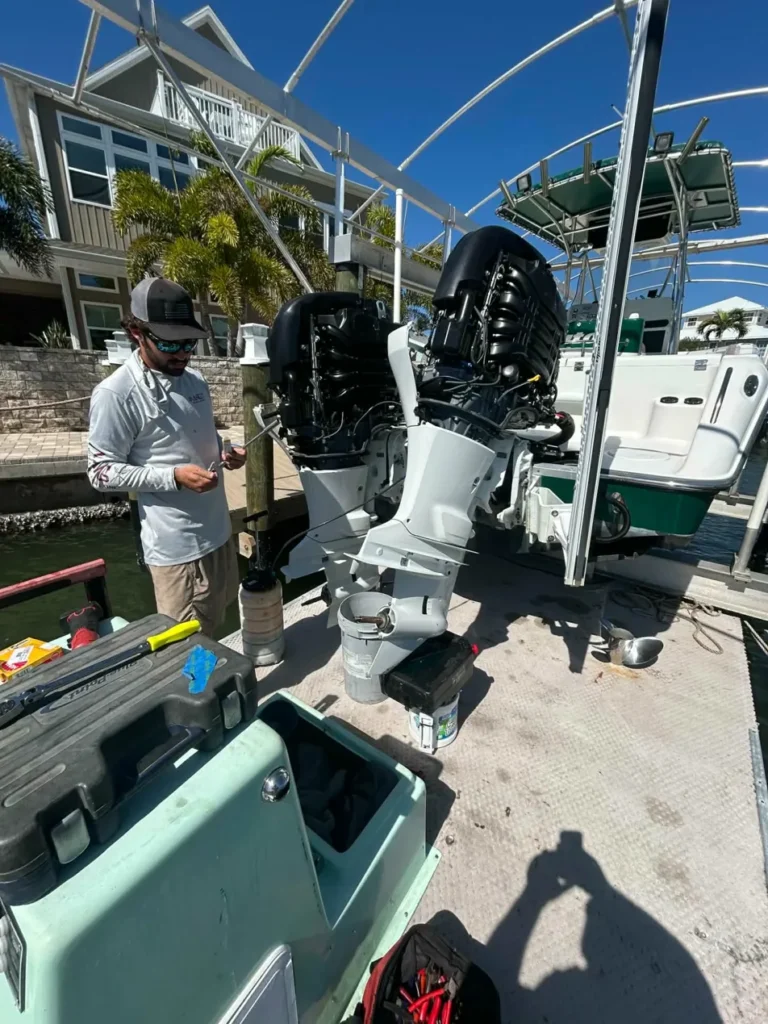
Often, yes, depending on the scope and the boat. Dockside service is genuinely useful for electrical troubleshooting, battery and distribution work, electronics wiring, and many rewiring projects, and it can be done at private docks, marinas, boat lifts, and residential waterfront. For a larger or more involved rewire, a technician may need additional access, removal of interior panels, or a different workspace, but a great deal of this work can happen right where your boat lives.
That convenience comes with a real diagnostic advantage. A mechanic who comes to the boat can see the conditions and the layout in person, trace circuits in place, and judge which wiring is still serviceable. If you are weighing your options, our breakdown of mobile service versus a traditional repair shop covers where each one makes the most sense.
Do Not Wait for a Complete Electrical Failure
The biggest mistake is waiting until the boat goes completely dead, or worse, until something overheats. A single flickering light is not an emergency. But flickering lights plus dead batteries plus corroded terminals plus multiple failed accessories plus undocumented wiring is a very different picture, and that combination is your boat asking for a comprehensive inspection.
Catching it early keeps you in control of the timeline and the budget. It is the difference between a planned, organized rewire and an unplanned failure on the water, a failed survey when you go to sell, or a fire you never saw coming. Early diagnosis almost always prevents more expensive damage down the line.
Frequently Asked Questions
How do I know if my boat needs a complete rewire or just a repair?
It comes down to whether the problems are isolated or widespread. One corroded terminal, one damaged wire, or one bad accessory circuit can be repaired cleanly if the rest of the system is healthy. But when corrosion, brittle insulation, tripping breakers, and random failures show up across multiple circuits, and problems keep migrating after you fix them, the harness itself is the issue and a full rewire is the sensible call. A proper inspection with voltage-drop testing is the only way to know for sure.
What is “black wire disease” and why does it matter?
Black wire disease is what happens when salt air wicks up under a wire’s insulation and oxidizes the copper inside, turning it black and brittle. The insulation can look fine from the outside while the conductor underneath has lost most of its ability to carry current. It causes voltage drop, overheating, and starved electronics, and once it has spread through a harness, new terminals will not bond or conduct properly. That is one of the clearest signals that spot repairs are no longer worth it.
Why do boats in Fort Myers need rewiring sooner than boats up north?
Southwest Florida stacks up saltwater, high humidity, intense heat, and constant vibration, and every one of those attacks marine wiring. Salt and condensation drive corrosion inside connections and behind panels, heat degrades insulation and loosens terminals, and vibration works splices loose. The result is that wiring here often reaches the end of its service life faster than the same wiring would in freshwater or a cooler climate. Corrosion should always be part of the diagnosis on an older saltwater boat.
How much does it cost to rewire a boat in Fort Myers?
There is no honest single price, because the scope varies enormously. A small center console with a simple DC system is a completely different job from a larger boat with multiple battery banks, shore power, a generator, electronics, and several distribution panels. How easy the wiring is to reach matters just as much, since buried runs behind finished panels take far longer than accessible ones. That is why a marine electrical inspection and a written scope of work should always come before any firm quote.
Is it safe to keep using my boat with these electrical problems?
Minor, isolated issues can usually wait for a scheduled repair, but certain signs should stop you. A burning-plastic smell, melted or scorched insulation, terminals that are hot to the touch, or breakers that trip repeatedly are active fire hazards, and stray current problems can create shock dangers in the water. If you are seeing any of those, stop using the affected system and have it inspected promptly. When in doubt, it is always safer to get a professional opinion before your next trip.
Get Your Boat’s Electrical System Inspected
Your boat’s wiring is its nervous system, and in our salt, heat, and humidity it has a real expiration date. A boat does not need a complete rewire just because it has one electrical problem, but when corrosion, aging wiring, repeated failures, and questionable past repairs show up across the whole system, continuing to patch symptoms is neither safe nor smart.
If several of the signs in this guide sound familiar, let a professional take a look before a small fault turns into a stranding or a fire. Reach out to Island Marine Repair LLC at (239) 839-6908 to schedule a dockside electrical inspection. We will trace the problems where your boat sits, tell you honestly which wiring is still good, and help you decide between a targeted repair and a complete rewire.
Island Marine Repair LLC provides mobile marine electrical service and complete boat rewiring throughout Fort Myers, Cape Coral, Naples, Punta Gorda, Captiva, Sanibel, and the surrounding Southwest Florida communities. Dockside service at your home lift, slip, or marina.