As the winter chill fades and the beautiful spring weather settles over Southwest Florida, it is time for boaters to prepare for prime days on the water. Each spring, responsible boat owners must perform a careful recommissioning—often referred to as “summerization”—to undo the effects of the winter layup. Taking a boat out of hibernation requires more than just turning the key; a thorough and methodical spring boat summerization checklist helps you catch small, easily fixable issues before they escalate into dangerous, day-ruining, and expensive problems.
Boating experts consistently advise verifying fluid levels, inspecting engine components, and testing electrical systems before your first launch of the season. At Island Marine Repair, our mobile technicians offer complete boat summerization services to walk through every single step of this process, ensuring your vessel is 100% water-ready.
To help you get started, we have broken down the ultimate spring recommissioning checklist into key categories you absolutely must inspect:

Exterior & Hull Integrity
Your boat’s hull is its first line of defense against the harsh marine environment. Begin with a comprehensive visual walk-around of the hull, deck, and transom. You are looking for any new blisters, stress cracks, spiderwebbing, or chalky, oxidized gelcoat. Make sure that the drain plug is present, the threads are clean, and all thru-hull fittings are tightly secured and free of marine growth.
After a winter of sitting in salt and sun, give the hull a rigorous wash and apply a high-quality, marine-grade wax or ceramic coating. This UV-protective barrier won’t just make your boat look showroom-new—it actively prevents sun fade, repels hard water spots, and helps corrosive saltwater sheet right off. If during your inspection you notice deep gouges, exposed fibers, or structural concerns, do not ignore them. Professional fiberglass repair is critical to maintaining your hull’s structural integrity and preventing devastating water intrusion over time. For the best cosmetic results, you can also schedule a professional boat detailing to brighten and protect the gelcoat and metal hardware.
Engine & Mechanical Systems
Your propulsion system needs serious TLC after sitting idle. Start by changing the engine oil and filter, as well as the lower-unit gear lube or transmission oil. Old oil can hold acidic moisture that eats away at internal components over the winter. Inspect all belts and rubber hoses for cracks, dry rot, or softness, replacing any that feel brittle.
Sand, silt, and shallow waters in Southwest Florida can absolutely ruin impellers. Therefore, it is highly recommended to replace the raw-water pump impeller if it is over a year old or if it sat dry all winter. Spin the propeller by hand to check for straightness; remove any fishing line wrapped tightly around the prop shaft (which can destroy prop seals), and ensure the blades have no deep nicks or dings. Even a microscopic bend in a prop blade can cause severe vibration, leading to lower unit damage.
Always flush the engine cooling system with fresh water after any saltwater launch to prevent internal scale and corrosion. Furthermore, be hyper-aware of how your engine sounds and feels during its first run. If your engine shows hesitation, vibrates excessively, or throws warning lights, you need to recognize the signs your boat needs mechanical service. Catching these hidden faults with our marine engine diagnostics before you head offshore can save you from a costly towing bill.
Electrical & Battery Health


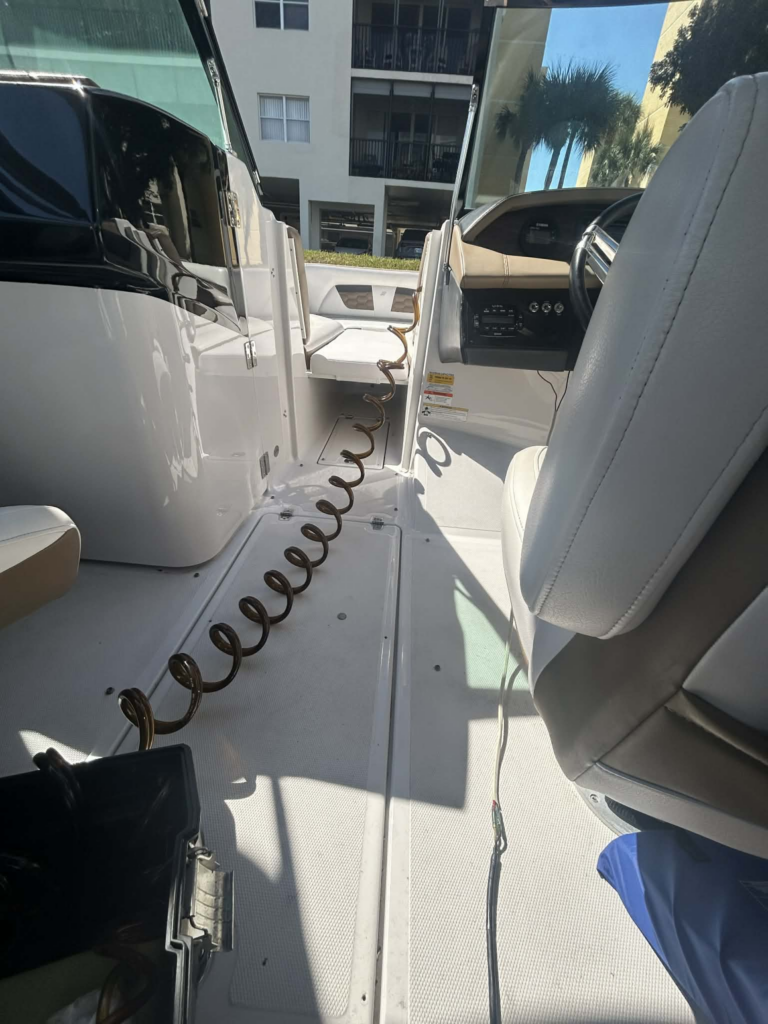
Marine electrical systems are notoriously finicky due to the constant exposure to moisture and salt. Start by testing the battery with a multimeter; a healthy 12V battery should read around 12.6 volts when fully charged. Give it a deep trickle charge if needed, and clean any white or green corrosion from the terminals using a wire brush and baking soda paste.
Verify that all navigation, anchor, and courtesy lights illuminate brightly, replacing burnt-out bulbs or upgrading to sealed LED fixtures where possible. Check the bilge pump by manually lifting its float switch or pouring a bucket of water directly into the bilge to ensure it automatically kicks on and swiftly pumps the water out. Inspect wiring looms under the center console and engine cowling: look for loose connections, parasitic draws, or chafing. Apply a high-quality anti-corrosion spray where wires enter the hull. If your wiring harness is a bird’s nest of old, frayed, or spliced wires, our boat rewiring service can replace outdated cables with marine-grade, tinned-copper wire to ensure all electronics and gauges are completely reliable.
Fuel System Maintenance
Modern fuels, particularly those containing ethanol, break down quickly and attract moisture, leading to a phenomenon known as “phase separation.” Carefully scan all fuel lines, tanks, primer bulbs, and fittings for leaks, strong fuel odors, or soft spots. Replace any old or cracked rubber hoses with USCG-approved, ethanol-resistant lines, and clamp all fittings tightly.
You must clean the fuel/water separator bowl and replace its internal filter element to guard your engine’s injectors against water contamination. If you neglected to add a high-quality marine fuel stabilizer in the fall, top off the tank with fresh, ethanol-free (REC-90) fuel and run the engine on a hose for a few minutes to circulate the fresh fuel through the system.
Safety Gear & Compliance
Safety should never be an afterthought. Take a full inventory of all required safety items. US Coast Guard and FWC regulations require one properly fitting, wearable PFD (life jacket) per passenger, plus a Type IV throwable device for vessels over 16 feet. Inspect them to make sure none are mildewed, waterlogged, or excessively faded with torn straps. If you use inflatable PFDs, check the CO2 cylinder indicator to ensure it is armed and green.
Confirm that all fire extinguishers are fully charged and current by reading their pressure gauges and date tags. Check the expiration dates on your visual distress signals (flares) and replace any that are older than 42 months from the date of manufacture. Finally, test the vessel’s fixed horn or handheld air horn to ensure it blasts loudly enough to signal other boaters. Keep in mind that FWC emphasizes that diligent safety gear upkeep not only keeps you legally compliant but keeps you ready for the unexpected. If you find your bilge pump or any vital float switches to be unreliable during this check, we offer full bilge pump service, including cleaning, testing, and replacement.
Interior, Comfort & Cabin Care
A clean boat is a happy boat. Thoroughly clean the inside of cabins, consoles, and cockpits. Wipe down all vinyl seats, marine carpets, and canvas enclosures with specialized marine cleaners. Look closely for hidden mildew spots—treat them promptly with a mold inhibitor before the spores spread in the Florida heat.
If your boat is equipped with plumbing, flush and sanitize the freshwater tanks and lines with a mild bleach solution, then rinse thoroughly. Test any onboard heaters, A/C units, or refrigeration components. Finally, restock your marine first-aid kit, check the expiration dates on all over-the-counter medicines or seasickness pills, and replenish your emergency ditch bag with extra dock lines, basic tools, zip ties, duct tape, and waterproof flashlights.
Navigation & Marine Electronics
Before navigating the ever-shifting sandbars of the Gulf Coast, update your GPS charts and depth-finder/sonar software to their latest firmware versions. Test your VHF radio by requesting a radio check on a non-emergency channel, and ensure the GPS antennas are acquiring satellites. Engine vibration and pounding waves can easily loosen connectors over time, so hand-tighten any loose coaxial cable fittings behind your helm.
Consider swapping in a fresh battery for your EPIRB or PLB if it’s more than a few years old or past its designated replacement date. Lastly, ensure that your chartplotter, marine stereo, and all USB/12V charging outlets are functioning so you can keep your phones powered while out on the water.
Fort Myers & Florida-Specific Tips
Florida’s intense UV rays, relentless sun, and dense salt air take a heavy toll on watercraft. Simply put, this climate is uniquely demanding. To protect your investment, spray exposed metals, engine blocks, and electrical terminations with a heavy-duty marine corrosion inhibitor (like Boeshield T-9 or CorrosionX). Apply a dedicated UV-protectant spray on all vinyl seating, dash components, and rubber trim to drastically slow down sun damage, fading, and cracking. For thru-hulls and unpainted underwater metals, applying a thin film of marine grease can actively block salt crystals from forming.
Because boating in the Sunshine State requires specific knowledge to prevent premature wear and tear, we highly recommend brushing up on the essential boat maintenance tips Florida owners often miss.
Additionally, with hurricane season always looming in the back of a Floridian’s mind, wildlife authorities advise taking proactive steps: always double and cross-lash your dock lines, remove or securely tie down bimini canvases, and ensure your batteries have enough juice to run the automatic bilge pumps through a multi-day torrential storm. Make sure your boat cover or structural supports are secure and tight to prevent water pooling. For comprehensive weather readiness at the end of the season, our boat winterization service can also properly prepare your vessel’s systems before shrink-wrapping or haul-out.
Let the Professionals Handle It
By rigorously following this expanded checklist, you’ll bring your boat back to life safely and efficiently. Each item on this list serves a distinct purpose: ensuring you’re not caught off-guard by a blown hose, a dead battery, or a sputtering engine once you finally hit the water with your family.
However, recommissioning a boat takes time, tools, and expertise. If you’d rather leave the dirty work to the pros, our highly trained team at Island Marine Repair offers full spring boat summerization services that expertly cover all of these steps. Whether you need a flawless hull wax, a comprehensive engine tune-up, a complex electrical check, or a complete bilge pump rebuild, we bring our fully-equipped mobile shop directly to your boat.
Contact Island Marine Repair today. Launch into summer with absolute confidence, knowing your vessel is seaworthy, safe, and entirely shipshape!